
The new Enola Holmes movie is a lot of fun, but you might have some questions about how she fits in with Sherlock Holmes, the law, and real-life history. Here are some answers!
Did Sherlock Holmes actually have a sister?
There is nothing in the stories written by Sir Arthur Conan Doyle referring to Sherlock Holmes having a sister, though there is nothing in his stories that says that Sherlock Holmes did not have a sister. Conan Doyle’s stories do clearly refer to a brother, Mycroft Holmes, who is a high-level government official (as indicated by the movie) and fat (which is not in the movie).
So where does Enola Holmes come from?
Sir Arthur Conan Doyle created and wrote Sherlock Holmes over the course of four novels and more than 50 stories, but anyone can write and publish new stories about Sherlock Holmes because most of the original stories are no longer protected by copyright law and are now in the public domain.
Author Nancy Springer created Enola Holmes in a book series that started in 2006. There are six books in the series, beginning with The Case of the Missing Marquess. The movie is based on Nancy Springer’s books, rather than on any of Doyle’s stories.
Can they do that?
Yes.
In 2014, a federal appellate court (the Seventh Circuit Court of Appeals) held that original stories that were based on the early Sherlock Holmes stories by Doyle could be published without the permission of Doyle’s estate and without any payments to Doyle’s estate. According to the court, the only parts of Sherlock Holmes that are not in the public domain are elements from the later stories, which are minor.
Sherlock Holmes, Mycroft Holmes, and Inspector Lestrade all appear in the early stories and are thus in the public domain.
The court sharply criticized of the Doyle estate for its attempts to seek demand from noted Sherlockian Leslie Klinger, who had brought the case.
“The Doyle estate’s business strategy is plain: charge a modest license fee for which there is no legal basis, in the hope that the ‘rational’ writer or publisher asked for the fee will pay it rather than incur a greater cost, in legal expenses, in challenging the legality of the demand,” Judge Richard Posner wrote. In effect, Klinger “was a private attorney general, combating a disreputable business practice – a form of extortion” and “has performed a public service.”
What about the Doyle estate’s lawsuit about this movie?
In June 2020, the Doyle estate did file a lawsuit in federal court in New Mexico against Nancy Springer, Penguin Random House, Legendary Pictures, Netflix and others about Enola Holmes. This lawsuit is still pending, but it has some major problems. Most notably, the main copyright argument is almost identical to the one that the Seventh Circuit Court of Appeals already rejected.
Another problem is that there is nothing in the books and movie that clearly seems to be based on the later stories for which the Doyle estate could claim a copyright.
The lawsuit focuses heavily on Holmes’ friendship with Watson, which it claims was only created in the later stories. In particular, the lawsuit focuses on the Three Garridebs, in which Watson was shot. Holmes reacts with concern and emotion: “You’re not hurt, Watson? For God’s sake, say that you are not hurt!” Watson is moved, writing that it was “worth a wound – it was worth many wounds – to know the depth of loyalty and love which lay behind that cold mask.”
There are some difficulties with this argument.
First, the friendship between Holmes and Watson was well-established in the stories that are in the public domain. Watson refers to Holmes as his friend in almost all of them, and Holmes refers to Watson as his friend in about half of them. Holmes also refers to Watson as “my dear Watson” in about two-thirds of the stories.
Second, the movie did make some changes that distinguish its version of Sherlock Holmes from the original version written by Sherlock Holmes, and thus may protect it from the lawsuit.
What makes this Sherlock Holmes different?
Several things distinguish the movie’s version of Sherlock Holmes from the original version written by Sir Arthur Conan Doyle.
First, the movie’s Sherlock has a much better attitude towards women. In the original stories, Sherlock Holmes does not have a high opinion of women generally, “used to make merry over the cleverness of women” and has an “aversion to women.” This changes slightly after Sherlock Holmes is outsmarted by Irene Adler in March 1888, when he investigated whether Adler was trying to blackmail an ex-boyfriend/lover. Afterwards, Holmes refers to Adler as “the woman,” and views her as “eclips[ing] and predominat[ing] the whole of her sex.” It is hard to imagine Sherlock Holmes giving such high regard to Irene Adler compared to two women who outsmarted him even more decisively: his mother and his sister.
Second, the movie’s Sherlock does not appear to have a Watson. In the original stories, Sherlock Holmes shared an apartment with his friend and colleague Dr. John Watson, whom he met around 1881, when Watson was recovering from the Battle of Maiwand and while Sherlock Holmes was still starting his career as a consulting detective. Watson helped build Sherlock Holmes’ reputation through the publication of his stories, and the two are partners and friends. Maybe we will see Watson in a sequel, but this is one of the rare instances when we see Sherlock Holmes without Watson.
Third, this Sherlock is famous much earlier than the original version. According to the classic stories, Sherlock Holmes was not famous as of 1884. According to the stories by Conan Doyle, Sherlock Holmes started becoming well-known as a result of Watson’s stories, which were published sometime beginning in the mid-1880s. Sherlock Holmes then became famous as a result of a particular case in 1887.
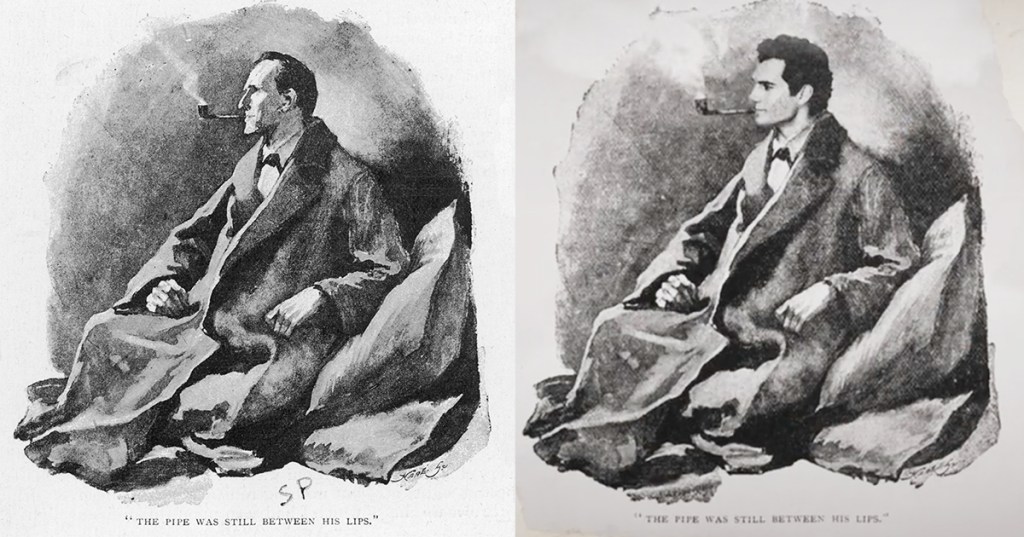
Finally, this Sherlock is probably much more handsome than the original version. Watson describes Sherlock Holmes as being striking in appearance – tall and “so excessively lean that he seemed to be considerably taller.” Holmes had “sharp and piercing” eyes, a “thin, hawk-like” nose that “gave his whole expression an air of alertness and decision,” and a prominent and square chin that “mark the man of determination.” But he was also not as neat as the club-going socialite seen in the movie – Watson says that “his hands were invariably blotted with ink and stained with chemicals.”
Compare the picture below on the left by Sidney Paget (from the story of the Man with the Twisted Lip) with the movie shot of Henry Cavill.
When do the movie and the book take place?
The movie takes place in 1884, as seen on the newspapers that the characters read. This puts the story in the early days of Sherlock Holmes’ long career.
According to the original stories by Sir Arthur Conan Doyle, Sherlock Holmes was in “active practice” for 23 years covering most of the 1880s and 1890s (with a break from 1891 through 1894 when he was believed to have died fighting master criminal James Moriarty). Sherlock retired in the early 1900s and then came out of retirement around 1912 to investigate German espionage.
The book version of Enola Holmes’ first case occurs around August 1888. This actually makes a lot of sense according to the chronology of Doyle’s stories.
First, Sherlock Holmes was famous by 1888, based on John Watson’s stories and a case involving the Netherland-Sumatra Company and the “colossal schemes of Baron Maupertuis,” one of the stories that is hinted at but never actually described by Sir Arthur Conan Doyle.
Second, Sherlock Holmes met Irene Adler in March 1888, months before he became re-acquainted with his sister in the book version of Enola Holmes. Irene Adler thus made a strong impression on Sherlock Holmes about the cleverness of women, an impression that would have lasted for a few months before he realized that he was surrounded by clever women.
The change from 1888 to 1884 may have been done to tie the movie’s plot to an actual voting reform bill in 1884.
Was there a reform bill like in the movie?
In the movie, there is a lot of discussion about a reform bill, and the suggestion is that the bill has something to do with women’s right to vote.
In real life, there actually was an important reform bill in 1884 which did extend the right to vote to more men, but not to women.
Women did not gain the right to vote in England until 1918, when women who were over the age of 30 and owned property were allowed to vote. Women finally gained the same right to vote as men in England in 1918.
So, what did you think about the movie?
I liked it, as did my wife and our 10-year-old daughter! It was fun, and Millie Bobby Brown and Henry Cavill were both great.
As a former prosecutor, I do think the movie does Sherlock Holmes a bit of a disservice in the scene where he walks into the police station and demands that Inspector Lestrade arrest the marquess’s grandmother.
The stories by Conan Doyle actually do show that Sherlock Holmes used good investigative practices. He went to crime scenes, he talked to witnesses, he followed up on leads, and he tested his theories before making accusations. He was not just an armchair detective, pronouncing guilt from on high or as if by magic.
Being a good investigator requires ambition and energy, as Holmes explained when contrasting himself with his brother Mycroft Holmes in the story the Greek Interpreter. Unlike Sherlock Holmes, Mycroft “will not even go out of his way to verify his own solutions, and would rather be considered wrong than take the trouble to prove himself right,” Holmes says. “He was absolutely incapable of working out the practical points which must be gone into before a case could be laid before a judge or jury.”
Sherlock Holmes would not have just walked into the police station and demanded that someone be arrested. Not without verifying his solutions and working out the practical points that would be necessary to convict the criminal beyond a reasonable doubt.
But that’s just me talking as a former prosecutor!
Enola Holmes herself did a good job investigating the case. She went to the scene of the crime, she picked up on things that witnesses told her, and she did not give up. She got lucky, but that is a big part of many investigations.
What will happen next?
There are five more books in the Enola Holmes series, so you can read those if you want to see what Enola does next. The first book ends with some more details about how Enola Holmes becomes a professional detective.
Sherlock Holmes’ life could be very different with a smart younger sister around. One thing that’s very interesting about the Sherlock Holmes stories is that most are supposedly written by John Watson, and a close reading shows that Watson may have lied about some things (for example, when Sherlock Holmes began investigating Professor Moriarty). Watson might have known about Enola Holmes and decided to leave her out of his stories to help protect her from their enemies.
Future movies could show how Enola Holmes was actually involved in some of her brother’s big cases. In particular, it would be really interesting to see what Enola did in 1891 when her brother faked his death!
Hope you enjoyed! Please let me know if you have any other questions or thoughts!
Stephen Lee was a federal prosecutor for 11 years and is now a lawyer in Chicago. He can be reached via email at stephenchahnlee@gmail.com or on Facebook at @stephenchahnlee
 Study in Sherlock: A Holmes Re-Read