Welcome to A Study in Sherlock: The Holmes Re-Read, where we will re-examine the great detective’s adventures. My name is Stephen Lee. I investigated and prosecuted real-life crimes and mysteries as a federal prosecutor in Chicago for 11 years and now help corporations and people as a white-collar criminal defense attorney. I also have written and spoken about how to build more effective cases using data, such as in my article “How to Build A Smoking Gun.” I will use those experiences here to look back at the Sherlock Holmes stories, with the help of my 13-year-old son and 10-year-old daughter.
For each story, we are going to provide a synopsis of the story as told by Dr. Watson (and occasionally by Sherlock Holmes) and then a synopsis of the story from another perspective, usually the person whose conduct was under investigation. We’ll also discuss how the story provides advice for real-life investigations. Holmes said in one story that he planned “to devote my declining years to the composition of a text-book which shall focus the whole art of detection into one volume” – we’ll try to do that for him! We’ll also discuss how contradictions in the stories might be reconciled in something that I call the “Silent Contest,” which refers to how Holmes and Watson might have lied in some early stories for investigative reasons.
The new Enola Holmes movie is a lot of fun, but you might have some questions about how she fits in with Sherlock Holmes, the law, and real-life history. Here are some answers!
Did Sherlock Holmes actually have a sister?
There is nothing in the stories written by Sir Arthur Conan Doyle referring to Sherlock Holmes having a sister, though there is nothing in his stories that says that Sherlock Holmes did not have a sister. Conan Doyle’s stories do clearly refer to a brother, Mycroft Holmes, who is a high-level government official (as indicated by the movie) and fat (which is not in the movie).
So where does Enola Holmes come from?
Sir Arthur Conan Doyle created and wrote Sherlock Holmes over the course of four novels and more than 50 stories, but anyone can write and publish new stories about Sherlock Holmes because most of the original stories are no longer protected by copyright law and are now in the public domain.
Author Nancy Springer created Enola Holmes in a book series that started in 2006. There are six books in the series, beginning with The Case of the Missing Marquess. The movie is based on Nancy Springer’s books, rather than on any of Doyle’s stories.
Sherlock Holmes, Mycroft Holmes, and Inspector Lestrade all appear in the early stories and are thus in the public domain.
The court sharply criticized of the Doyle estate for its attempts to seek demand from noted Sherlockian Leslie Klinger, who had brought the case.
“The Doyle estate’s business strategy is plain: charge a modest license fee for which there is no legal basis, in the hope that the ‘rational’ writer or publisher asked for the fee will pay it rather than incur a greater cost, in legal expenses, in challenging the legality of the demand,” Judge Richard Posner wrote. In effect, Klinger “was a private attorney general, combating a disreputable business practice – a form of extortion” and “has performed a public service.”
What about the Doyle estate’s lawsuit about this movie?
In June 2020, the Doyle estate did file a lawsuit in federal court in New Mexico against Nancy Springer, Penguin Random House, Legendary Pictures, Netflix and others about Enola Holmes. This lawsuit is still pending, but it has some major problems. Most notably, the main copyright argument is almost identical to the one that the Seventh Circuit Court of Appeals already rejected.
Another problem is that there is nothing in the books and movie that clearly seems to be based on the later stories for which the Doyle estate could claim a copyright.
The lawsuit focuses heavily on Holmes’ friendship with Watson, which it claims was only created in the later stories. In particular, the lawsuit focuses on the Three Garridebs, in which Watson was shot. Holmes reacts with concern and emotion: “You’re not hurt, Watson? For God’s sake, say that you are not hurt!” Watson is moved, writing that it was “worth a wound – it was worth many wounds – to know the depth of loyalty and love which lay behind that cold mask.”
There are some difficulties with this argument.
First, the friendship between Holmes and Watson was well-established in the stories that are in the public domain. Watson refers to Holmes as his friend in almost all of them, and Holmes refers to Watson as his friend in about half of them. Holmes also refers to Watson as “my dear Watson” in about two-thirds of the stories.
Second, the movie did make some changes that distinguish its version of Sherlock Holmes from the original version written by Sherlock Holmes, and thus may protect it from the lawsuit.
What makes this Sherlock Holmes different?
Several things distinguish the movie’s version of Sherlock Holmes from the original version written by Sir Arthur Conan Doyle.
First, the movie’s Sherlock has a much better attitude towards women. In the original stories, Sherlock Holmes does not have a high opinion of women generally, “used to make merry over the cleverness of women” and has an “aversion to women.” This changes slightly after Sherlock Holmes is outsmarted by Irene Adler in March 1888, when he investigated whether Adler was trying to blackmail an ex-boyfriend/lover. Afterwards, Holmes refers to Adler as “the woman,” and views her as “eclips[ing] and predominat[ing] the whole of her sex.” It is hard to imagine Sherlock Holmes giving such high regard to Irene Adler compared to two women who outsmarted him even more decisively: his mother and his sister.
Second, the movie’s Sherlock does not appear to have a Watson. In the original stories, Sherlock Holmes shared an apartment with his friend and colleague Dr. John Watson, whom he met around 1881, when Watson was recovering from the Battle of Maiwand and while Sherlock Holmes was still starting his career as a consulting detective. Watson helped build Sherlock Holmes’ reputation through the publication of his stories, and the two are partners and friends. Maybe we will see Watson in a sequel, but this is one of the rare instances when we see Sherlock Holmes without Watson.
Third, this Sherlock is famous much earlier than the original version. According to the classic stories, Sherlock Holmes was not famous as of 1884. According to the stories by Conan Doyle, Sherlock Holmes started becoming well-known as a result of Watson’s stories, which were published sometime beginning in the mid-1880s. Sherlock Holmes then became famous as a result of a particular case in 1887.
Finally, this Sherlock is probably much more handsome than the original version. Watson describes Sherlock Holmes as being striking in appearance – tall and “so excessively lean that he seemed to be considerably taller.” Holmes had “sharp and piercing” eyes, a “thin, hawk-like” nose that “gave his whole expression an air of alertness and decision,” and a prominent and square chin that “mark the man of determination.” But he was also not as neat as the club-going socialite seen in the movie – Watson says that “his hands were invariably blotted with ink and stained with chemicals.”
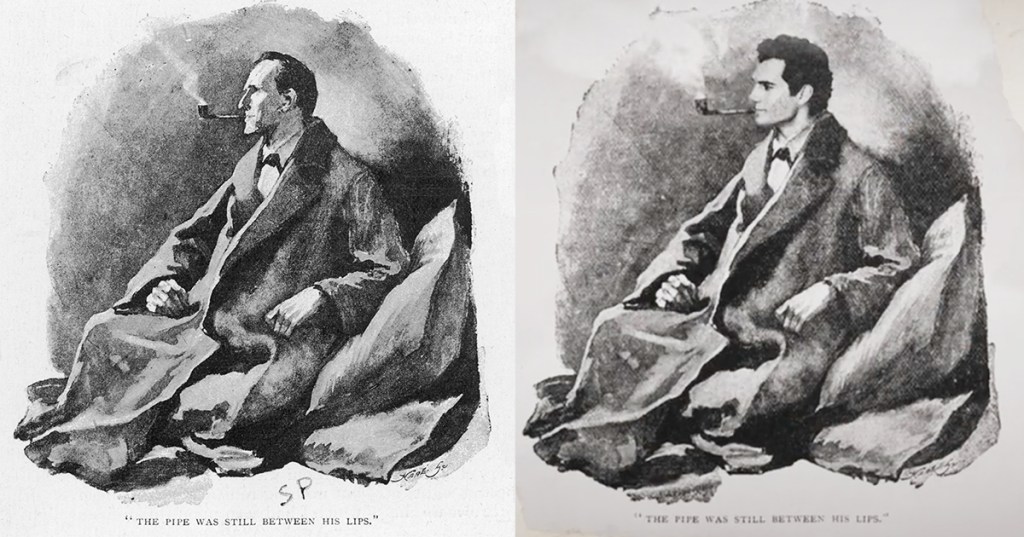
Compare the picture below on the left by Sidney Paget (from the story of the Man with the Twisted Lip) with the movie shot of Henry Cavill.
Classic Sherlock Holmes as drawn by Sidney Paget on the left, and Henry Cavill’s Sherlock Holmes on the right.
When do the movie and the book take place?
The movie takes place in 1884, as seen on the newspapers that the characters read. This puts the story in the early days of Sherlock Holmes’ long career.
According to the original stories by Sir Arthur Conan Doyle, Sherlock Holmes was in “active practice” for 23 years covering most of the 1880s and 1890s (with a break from 1891 through 1894 when he was believed to have died fighting master criminal James Moriarty). Sherlock retired in the early 1900s and then came out of retirement around 1912 to investigate German espionage.
The book version of Enola Holmes’ first case occurs around August 1888. This actually makes a lot of sense according to the chronology of Doyle’s stories.
First, Sherlock Holmes was famous by 1888, based on John Watson’s stories and a case involving the Netherland-Sumatra Company and the “colossal schemes of Baron Maupertuis,” one of the stories that is hinted at but never actually described by Sir Arthur Conan Doyle.
Second, Sherlock Holmes met Irene Adler in March 1888, months before he became re-acquainted with his sister in the book version of Enola Holmes. Irene Adler thus made a strong impression on Sherlock Holmes about the cleverness of women, an impression that would have lasted for a few months before he realized that he was surrounded by clever women.
The change from 1888 to 1884 may have been done to tie the movie’s plot to an actual voting reform bill in 1884.
Was there a reform bill like in the movie?
In the movie, there is a lot of discussion about a reform bill, and the suggestion is that the bill has something to do with women’s right to vote.
In real life, there actually was an important reform bill in 1884 which did extend the right to vote to more men, but not to women.
I liked it, as did my wife and our 10-year-old daughter! It was fun, and Millie Bobby Brown and Henry Cavill were both great.
As a former prosecutor, I do think the movie does Sherlock Holmes a bit of a disservice in the scene where he walks into the police station and demands that Inspector Lestrade arrest the marquess’s grandmother.
The stories by Conan Doyle actually do show that Sherlock Holmes used good investigative practices. He went to crime scenes, he talked to witnesses, he followed up on leads, and he tested his theories before making accusations. He was not just an armchair detective, pronouncing guilt from on high or as if by magic.
Being a good investigator requires ambition and energy, as Holmes explained when contrasting himself with his brother Mycroft Holmes in the story the Greek Interpreter. Unlike Sherlock Holmes, Mycroft “will not even go out of his way to verify his own solutions, and would rather be considered wrong than take the trouble to prove himself right,” Holmes says. “He was absolutely incapable of working out the practical points which must be gone into before a case could be laid before a judge or jury.”
Sherlock Holmes would not have just walked into the police station and demanded that someone be arrested. Not without verifying his solutions and working out the practical points that would be necessary to convict the criminal beyond a reasonable doubt.
But that’s just me talking as a former prosecutor!
Enola Holmes herself did a good job investigating the case. She went to the scene of the crime, she picked up on things that witnesses told her, and she did not give up. She got lucky, but that is a big part of many investigations.
What will happen next?
There are five more books in the Enola Holmes series, so you can read those if you want to see what Enola does next. The first book ends with some more details about how Enola Holmes becomes a professional detective.
Future movies could show how Enola Holmes was actually involved in some of her brother’s big cases. In particular, it would be really interesting to see what Enola did in 1891 when her brother faked his death!
Hope you enjoyed! Please let me know if you have any other questions or thoughts!
Stephen Lee was a federal prosecutor for 11 years and is now a lawyer in Chicago. He can be reached via email at stephenchahnlee@gmail.com or on Facebook at @stephenchahnlee
How many murders and how many murderers are there in The Sign of Four? Definitely two murders committed by at least five murderers, but maybe more.
First, based on the words of Jonathan Small himself, in 1857 or 1858, Jonathan Small joins a conspiracy with Mahomet Singh, Abdullah Khan and Dost Akbar to kill the merchant Achmet and steal a treasure comprised of precious stones and pearls. The merchant tries to escape, but Small trips him, and the merchant dies, either from the fall or from subsequent knife wounds.
Second, in 1888, Tonga kills Bartholomew Sholto with a poison dart. Small claims that he had not intended to kill Bartholomew Sholto, and thus claims that he is not responsible for the murder, only Tonga. “I don’t believe that I can swing over the job,” Small tells Holmes.
The law, however, probably would disagree. Under English and American law, a person committing certain dangerous crimes such as burglary is responsible for murders caused by their partners in the course of the crime, a principle called “felony murder.” Small was committing burglary with Tonga, and likely knew that Tonga had poison darts with him. Small thus would likely be guilty of murder under the felony murder rule, even if he did not actually intend to kill Bartholomew Sholto himself.
Those two murders are clear, with one murder committed by four people and the second murder committed by one or possibly two.
But there likely are two other murders.
A third murder probably occurred when Jonathan Small escaped from the Andaman Islands. Small says that he used his wooden leg to attack a guard “who had never missed a chance of insulting and injuring me.” Small says that he “struck him full, and knocked the whole front of his skull in,” and that he left the guard “lying quiet enough.” It is not absolutely clear that Small killed this guard, but it sounds probable.
The fourth possible murder involves the death of Mary Morstan’s father.
According to Thaddeus Sholto, his father, Major John Sholto, revealed on his deathbed in 1882 that he had been present when Captain Morstan died four years earlier.
According to Thaddeus, Major Sholto said that Captain Morstan had confronted him over the Agra treasure and about Sholto’s keeping the treasure all for himself. “Morstan had sprung out of his chair in a paroxysm of anger, when he suddenly pressed his hand to his side, his face turned a dusky blue, and he fell backwards, cutting his head against the corner of the treasure-chest.”
A very convenient story.
Assuming that we can believe Thaddeus’s account, Major Sholto probably lied to his sons by claiming that Captain Morstan’s death was just an accident. More likely, Major Sholto probably struck Captain Morstan, knocking him into the chest and causing his death. Major Sholto then covered up the death rather than risk investigation.
By the end of the Sign of Four, Holmes has cleared Thaddeus Sholto for the murder of his brother Bartholomew. But the story might get more complicated afterwards.
By Thaddeus’s account, Major Sholto’s servant Lal Chowdar was an accomplice after the fact to the murder of Captain Morstan by helping Major Sholto hide the body. Chowdar could be prosecuted as an accomplice and probably would be encouraged to at least reveal the location of the body.
And Thaddeus himself could face prosecution connected to the death of Captain Morstan.
By his own words, Thaddeus was aware that a felony had been committed as of 1882. He then stayed silent for years afterwards, keeping silent for personal benefit. English law at the time recognized that not reporting knowledge of a crime could be a crime in and of itself (misprision of felony), and U.S. federal law still recognizes misprision of felony as a crime today. English law might have recognized an exception for not reporting the crimes of a close relative, especially one who had died, but it might not excuse Thaddeus for failing to report Chowdar’s involvement.
Moreover, Thaddeus himself might be an accomplice to the murder himself, especially if Chowdar cooperates against him. Thaddeus’s story might have been as self-serving as his father’s, and he might have known more earlier than he claimed.
The Sign of Four is the second Sherlock Holmes novel, and it involves two murders (maybe more), corrupt soldiers, revenge, a chase, and a love story. To fully understand it, we have to go back to the origin of the crime: the robbery of the Agra treasure.
• Jonathan Small was a soldier in India during the Sepoy Mutiny, which occurred in India in 1857 and 1858.
• Small was forced to participate in the robbery by three Sikhs, and they made an oath to share the treasure, which is the “sign of the four” mentioned in the title.
• They were caught and Small was imprisoned on the Andaman Islands.
• Small made a deal with Arthur Morstan and John Sholto that they would get a fifth share if they aided in the four’s escape.
• However, Sholto double-crossed them and returned to England with the treasure.
• Morstan went to England to sort things out, but because of his weak health, had a heart attack and died, at least according to Sholto.
• Small vowed revenge on Sholto and escaped four years later with an islander named Tonga. This news shocked Sholto and caused him to become fatally ill.
• On his deathbed, Sholto told his sons about the treasure, but before he could divulge the location, Small appeared and Sholto died.
• When Bartholomew Sholto found the treasure, Small and Tonga went to Pondicherry Lodge to steal it. Tonga killed Bartholomew in the process.
Sherlock Holmes gets involved indirectly. He is called upon by Mary Morstan, who received a mysterious message from Sholton’s son Thaddeus. He then discovers that Thaddeus’s brother Bartholomew has been killed, quickly deduces that the crime was committed at least in part by Jonathan Small, and helps clear Thaddeus’s name by catching Small.
Sherlock Holmes may be able to keep track of all this in his mind without taking notes, but I could not! We get very detailed accounts from three different witnesses, including one witness who recounts what another witness said. Some details do not fit together, and some of the witnesses are probably not telling the complete truth.
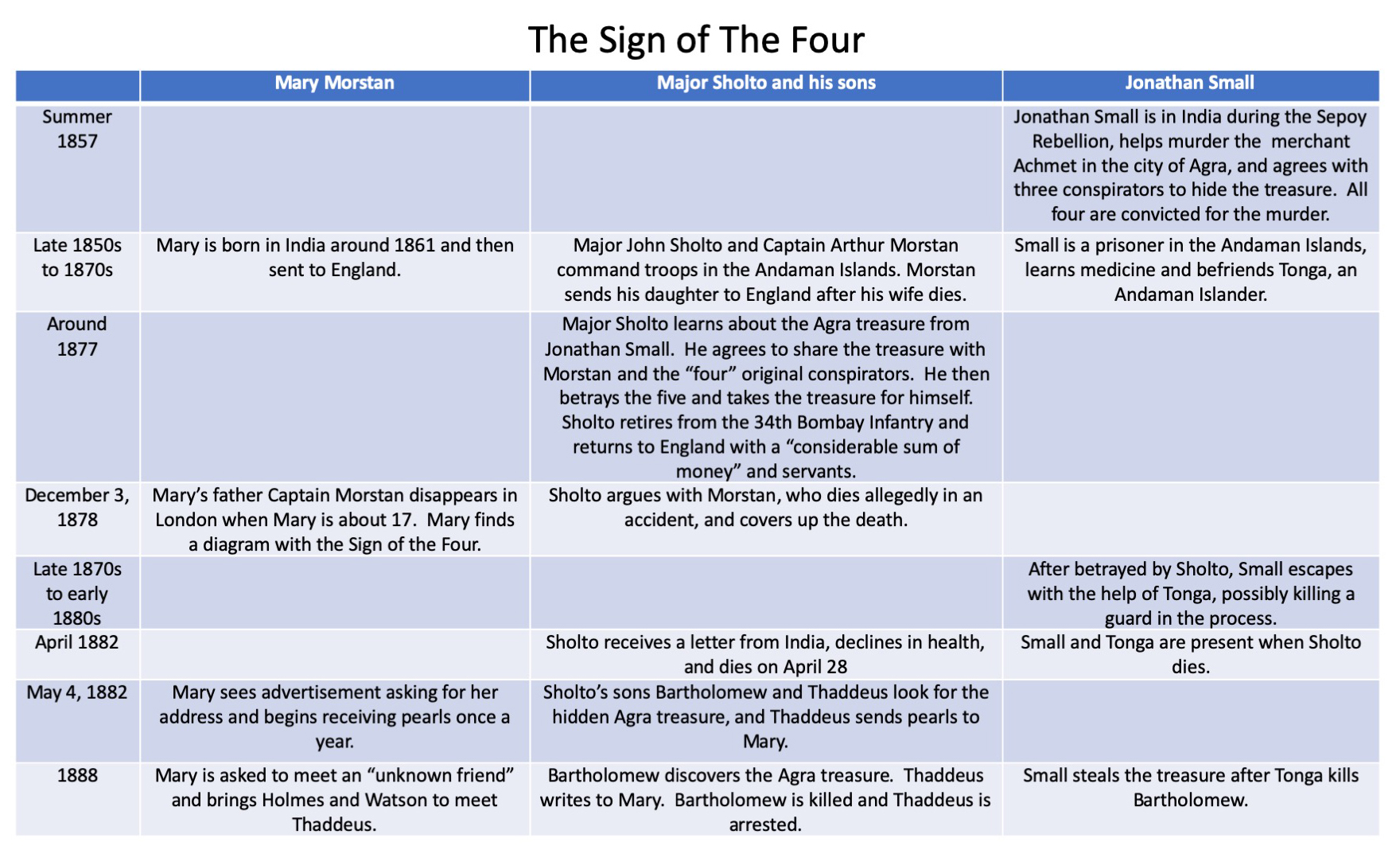
When I investigate real-life crimes, I often make chronological tables that track events by the person who did or observed them. These sometimes help me determine how a crime develops, what witnesses are important, and what actually happened. I thought one might be helpful in explaining the events of the Sign of Four, where Holmes and we learn what happened through three different perspectives.
Here is the story from the perspectives of Mary Morstan, Major John Sholto (and his sons), and Jonathan Small, all before Sherlock Holmes gets involved.
This helps us determine what events must be true, particularly the ones that can be corroborated by outside evidence. Morstan’s disappearance and Sholto’s death are facts that were reported in newspapers (according to Watson and Holmes) and are probably credible.
Small’s account of Sholto’s death matches up with Thaddeus’s, so those accounts are probably true.
Of course, there is one huge claim by a witness that has no corroboration within the story and that suggests that another crime may have occurred. We’ll discuss that next time.
Sherlock Holmes is a great series for kids as well as adults. It includes lots of action and funny scenes, and while there is some violence they aren’t really inappropriate.
I really enjoyed them because it was fun to see how Sherlock Holmes instantly knew many things about people just from seeing their clothes and physical characteristics. I think that can be kind of funny at times because he just does it so quickly, and also because Conan Doyle includes the reactions of others witnessing Holmes’ deductions, which I think are pretty funny.
Another reason why I think kids should read the Sherlock Holmes stories is because it’s fun to try to solve the case with Holmes and compare your thoughts to his. Like how Holmes said that he studied a thousand cases, maybe if you read the stories enough you can eventually come to the same conclusions as him if you haven’t already.
A few Sherlock Holmes stories also include action scenes or just clever tricks which usually involve Holmes and sometimes even Watson using disguises to outwit his enemies. His disguises often can even fool the people working with him, and it’s also funny to see their reactions to realizing it was actually him. They also sometimes can fool you and it’s cool to see how everything plays out into Holmes solving the case.
I started reading Sherlock Holmes with the first story, a Study in Scarlet, but there are multiple books kids can start with. There are actually two types of Sherlock Holmes stories, novels, which include chapters and are much longer than others, and the short stories, which are shorter and less detailed.
A Study in Scarlet, (which the name A Study in Sherlock is based off of) is a good first story as well as the actual first story in the whole series. It’s the first, introductory story, so in general it would be great to start with. It doesn’t have as much action as others, and it’s a novel, so it’s a bit slow, and I think it’s not really the most exciting. Even though, it includes most of the background information if you’re not familiar with the general theme. My dad recommends that if you start with this story, you could probably skip the second part (the part from the bad guy’s perspective) since it is “boring and irrelevant to the plot”. Otherwise it’s a pretty good story to start with.
The Red-Headed League is also a good story to start with even though it’s not the first chronologically, since the crime and the way Holmes catches the criminals are pretty clever. It’s pretty actiony and it teaches a bunch of good lessons. It’s a short story, but it still introduces the concept pretty well and I think it’s pretty good to start with. (Also it is not violent.) My dad recommends this story because it is “the perfect Sherlock Holmes story.” It’s probably not perfect, but I still like it a lot and you could definitely start with this.
The Baker Street Irregulars books are also great to start with. They probably don’t introduce Holmes as well since it’s not from Watson’s point of view like the others, but they were written with kids in mind unlike the others and are also from the point of view of kids. If you don’t know who they are, the Baker Street Irregulars are basically a bunch of kids who work for Holmes. According to him, they are the “Baker Street division of the police force”. They go around gathering information for him and helping him do active work. The books are a spin-off series that have three books with the last one based on an original Sherlock Holmes story, the Final Problem. The other two are made-up crimes but still have lots of action and are pretty hard to solve. They aren’t as non-violent as others but have no deaths. Overall, they aren’t original to the series but still pretty good to start with.
Another synopsis from the point of the view of the criminal
Reasoning Backward – How Holmes solved the crime
The Art of Detection – lessons for real-life investigators and investigations
Recurring Characters
History Accuracy
Timeline
And here is our video about the story:
Synopsis (by Allison Lee)
Dr. Watson was a medical doctor working for the war in Afghanistan. When he returns to London due to a war injury, he has no place to live, but a friend introduces him to Sherlock Holmes, who decides to board with Watson. While they live together, Dr. Watson begins to suspect something of Holmes and starts observing his unusual habits. Finally, Holmes informs Watson of his occupation as a consulting detective.
One day, a man named Inspector Gregson arrives at their home, asking for Holmes’ help in solving a case on the murder of Enoch Drebber. Holmes and Watson rush to the crime scene with Inspectors Lestrade and Gregson from Scotland Yard. When they arrive, Holmes analyzes the body and notes several things, choosing to share only a few with Scotland Yard. At the crime scene, they discover a ring by the victim’s body that Holmes takes as well as the German word RACHE written in blood, meaning revenge. Holmes and Watson put up advertisements for the missing ring, hoping to catch the culprit. However, instead of the culprit they meet an old woman who takes the ring and leaves. Holmes follows the woman, but she throws him off by seeming to have jumped off the cab in motion. This led Holmes to believe it was actually not an old woman but an accomplice.
Afterwards, Inspector Gregson arrives, claiming to have figured out and arrested the culprit, a man named Arthur Charpentier. He explained how he got to that point, but as he finished, Lestrade came and told them that Drebber’s secretary, Joseph Stangerson, who Lestrade had believed was the culprit, had been killed with the German word RACHE written above his body, like how it had been written above Drebber’s. Lestrade finally told them of some pills he had found lying by Stangerson’s body.
When he heard that, Holmes jumped up and announced his case was complete. He told Watson to get an old, dying dog and put a piece of one pill with water into its mouth. When it didn’t do anything, he tried the other pill, which killed the dog immediately. At this point, the Baker Street Irregulars came in and told Holmes they had the cab. Holmes invited the cabman up and handcuffed him, introducing him as Jefferson Hope, the murderer of Drebber and Stangerson.
Another Point of View (“Let us put ourselves in the place of [the criminal]. Let us look at it from his point of view”)
We read the Sherlock Holmes stories primarily from the point of view of Dr. John Watson, but Holmes and Watson are typically coming to the story late in the game, after crimes and other events have already been put into motion. Turning the stories around, and looking at them from another point of view, may make things clearer.
Here, Jefferson Hope had been a prospector, a pioneer, a scout, a trapper, a silver explorer, and a ranchman. But his life changed forever in 1859 when he fell in love with and became engaged to Lucy Ferrier, the 17-year-old daughter of a prosperous farmer named John Ferrier in Utah.
Jefferson Hope left to work a mine, intent to come back with his own fortune and to marry Lucy upon his return. Unfortunately, what he did not know was that while he was away, John Ferrier was facing pressure to have Lucy wed someone else: either Enoch Drebber or Joseph Stangerson. John Ferrier sent word to Jefferson Hope, and Hope came back just in time.
The three fled and thought they had escaped. Unfortunately, they were wrong.
One day, Drebber and Stangerson found the Ferriers by themselves while Hope was away hunting. Stangerson shot and killed John Ferrier, leaving Ferrier’s body in a shallow grave.
Lucy Ferrier may have had it worse. She was forced to choose between Stangerson, the man who had killed her father, and Drebber, the man who had only participated in the killing of her father. She chose the lesser of two evils and married Drebber. Heartbroken, she died just weeks later.
Jefferson Hope had lost the love of his life, and he sought revenge, a slow, torturous process that took years and years. To support himself on his quest, he worked mines and worked odd jobs, including being a janitor at a college where he gained a poison that he planned to use to seek his own form of justice. Jefferson Hope got closest to Drebber and Stangerson in Cleveland, but they had him arrested and fled to Europe while he was in jail.
Finally, about 20 or so years after the death of John Ferrier and Lucy Ferrier, Jefferson Hope tracked Drebber and Stangerson to London and then worked as a cab driver while following them. He was running out of time, as his heart had become weaker, and he knew that he did not have much more time to bring Drebber and Stangerson to justice.
Finally, one night, Hope picked up Drebber and brought him to an abandoned house, where he gave Drebber a chance. Two pills – one benign, and the other filled with poison. Fate would decide. Hope and Drebber each took a pill, and Drebber died.
Hope left Drebber’s body behind but accidentally dropped Lucy’s wedding ring in the house. Hope tried to return for the ring but was too late – a police officer had noticed lights in the house and had found Drebber’s body. Hope abandoned the ring. He had more work to do.
Hope then tried to find Stangerson, who was staying at a private hotel. While staking Stangerson out, he saw a newspaper announcement about a wedding ring found near the house. Jefferson Hope feared a trap, and sent a friend in his place to get the ring. The friend went to 221B Baker Street in disguise as an old woman, got the ring back, and managed to escape the detective who tried to follow him. The friend brought the ring back to Hope. Hope then broke into Stangerson’s hotel room, intending to offer Stangerson the same 50/50 chance that he had offered Drebber. Stangerson fought back, and Hope ended up stabbing him in the heart.
Hope had finally managed his own form of justice. Lucy and John Ferrier could rest in peace.
Reasoning Backward (“In solving a problem of this sort, the grand thing is to be able to reason backwards”)
Holmes begins his investigation by closely observing the crime scene, which led to him deducing some details about his suspect, the most important being that the suspect was a cabbie.
The murderer was a cabby who had driven the victim to the scene in a horse-driven cab. Holmes saw that the murderer and the victim had walked into the house together, and that the horse had been left unattended, as indicated by the marks which Holmes found in the ground. “It is absurd to suppose that any sane man would carry out a deliberate crime under the very eyes, as it were, of a third person who was sure to betray him,” Holmes reasoned. The cabby, therefore, was the murderer.
More than six feet high. Based on the length of his stride.
Small feet for his height, wearing square-toed boots. Holmes measured foots outside.
Smoked a Trichinopoly cigar. Based on ash from the floor. Holmes had made a special study of cigar ashes and had written a monograph on the subject.
Fingernails of right hand were remarkably long. Scratches in the wall where he had written Rache in blood
Holmes then figured out that the murder was committed by poison. He then found out some information about the victim, which established a motive and the name of a possible suspect, Jefferson Hope (Holmes also could have found this out based on the telegram found at the second murder scene, Joseph Stangerson’s hotel room).
Holmes then combined the information and sent out his Baker Street Irregulars to ask for Jefferson Hope to pick him up and to set up a situation where he could get Hope to confess.
The Art of Detection
Holmes said in the Adventure of the Abbey Grange that someday he would compose a “text-book which shall focus the whole art of detection into one volume.” Unfortunately, he never got around to doing this, but this story offers some useful advice for real-life investigations.
Know a lot about other cases. Holmes knows what to look for when he gets to a murder scene because he knows a lot about other murder scenes. This is the thing that distinguishes Holmes from other detectives, and this is what I found myself as I did more and more cases. The first time you investigate a bank robbery, everything is new. The 10th time, you know what to look for.
Holmes: “I’m a consulting detective, if you can understand what that is. Here in London we have lots of Government detectives and lots of private ones. When these fellows are at fault they come to me, and I manage to put them on the right scent. They lay all the evidence before me, and I am generally able, by the help of my knowledge of the history of crime, to set them straight. There is a strong family resemblance about misdeeds, and if you have all the details of a thousand at your finger ends, it is odd if you can’t unravel the thousand and first.”
Get out there and talk to people directly. Holmes did not just rely on what he was told about the crime scene, but went directly to the constable who found Drebber’s body, John Rance (evidentiary rules similarly favor firsthand observations, rather than “hearsay”). By doing so, Holmes was able to get details that confirmed his theories about what had happened, and he learned about the man who happened to be outside the house shortly afterwards.
Holmes: “There is nothing like first-hand evidence … We may as well learn all that is to be learned.”
Look closely at the unusual fact, the facts that stand out, the unintended mistakes. Holmes looked closely at the evidence that was unusual – the cab that was left unattended during the murder, the wedding ring that was found on the scene – and those unusual facts led him to Jefferson Hope. Similarly, when I try to investigate a case, I look for mistakes or flaws in the pattern.
Holmes: “What is out of the common is usually a guide rather than a hindrance. In solving a problem of this sort, the grand thing is to be able to reason backward.”
Holmes: “When a fact appears to be opposed to a long train of deductions, it invariably proves to be capable of bearing some other interpretation.”
Holmes: “It is a mistake to confound strangeness with mystery. The most commonplace crime is often the most mysterious because it presents no new or special features from which deductions may be drawn. This murder would have been infinitely more difficult to unravel had the body of the victim been simply found lying in the roadway without any of those outré and sensational accompaniments which have rendered it remarkable. These strange details, far from making the case more difficult, have really had the effect of making it less so.”
Focus on who benefits. Motive helps identify a suspect and it can help develop evidence. Here, Holmes knew that the killer had some motive tied to a wedding ring, asked for information specifically about Drebber’s marriage, and then learned about Jefferson Hope and about Hope’s presence in Europe. When I was a young prosecutor, I was taught to consider two benefits – profit and passion. Most of the crimes I prosecuted were for profit, money. This is a crime based on passion, specifically, revenge.
Test your theory. Holmes suspected that the wedding ring was important, but did not know why. He tested his theory by placing an advertisement in the newspaper to see who would show up looking for it. Holmes suspected that the murder had been committed by poison. He tested his theory by conducting an experiment with the two pills Lestrade found at the scene of Stangerson’s death – giving part of each pill to an old dog, which died quickly after trying the second pill.
Recurring Characters
This is the first Sherlock Holmes story, the first John Watson story, the first story featuring Inspectors Gregson and Lestrade, and the first story with the Baker Street Irregulars. We will see all of these characters again in future stories.
Holmes compliments Gregson and Lestrade, but with lots of qualifications. He says that they “are the pick of a bad lot. They are both quick and energetic, but conventional – shockingly so. They have their knives into one another, too. They are as jealous as a pair of professional beauties.” He refers to Lestrade as “that fool” “who thinks himself so smart.”
All that being said, while both investigators miss the signs pointing to a cabby being the murderer, both do a decent job pursuing leads. Gregson investigated the victim and found someone else who might have a motive to kill Hope, even though that suspect did not fit all of the information available and was arrested by mistake. Lestrade investigated the victim’s associate (Stangerson), discovered that Stangerson had also been killed, and discovered a telegram that might have led to Jefferson Hope. Even if Holmes had not been involved, Lestrade might have identified Hope as the murderer eventually.
Regarding the Baker Street Irregulars, the young “ragged street Arabs” who assist Holmes in his investigations and who manage to lure Jefferson Hope to 221B Baker Street. Only one is named – Wiggins, who also appears in the Sign of the Four. Holmes says that these “little beggars” are helpful because they are so often ignored. “The mere sight of an official-looking person seals men’s lips. These youngsters, however, go everywhere and hear everything. They are as sharp as needles, too; all they want is organization.”
Historical Accuracy
This is one of the few Sherlock Holmes stories to involve a real-life person: Brigham Young, a leader of the Church of Latter-Day Saints, who later became the governor of Utah and the namesake for Brigham Young University. The story praises Young as a “skilful administrator as well as a resolute chief” and acknowledges the “persecution” that Mormons suffered, but then grounds Jefferson Hope’s motives in what the Church of Latter-Day Saints has called “a longstanding and much-embellished myth about a secret society of Mormon vigilantes.”
According to the story, John Ferrier and Lucy were the only survivors of a disastrous group of Western settlers, originally 21 in number. On May 4, 1847, they were found and saved by a group of Mormon settlers led by Brigham Young.
In fact, Brigham Young was leading a company of Mormons in May 1847 as they left the Midwest because of religious persecution that they had faced. According to the Mormon Overland Travel Database, the company consisted of 142 men, 3 women, 2 children and 72 wagons. The database lists the members of the company – not surprisingly, no Drebber, no Stangerson, and no Ferrier are listed.
The story picks up again around 1859 or 1860, when Lucy is about 17 or 18 years old. At this time, Brigham Young confronts John Ferrier, telling him that Lucy must marry Enoch Drebber or Joseph Stangerson. Young supposedly invokes an alleged rule proclaiming that a woman marrying a “Gentile” would be committing a “grievous sin.” There is no such explicit rule, but the Mormon religion does encourage marrying within one’s faith, similar to other. Mormons believe in “celestial marriage,” which continues into the afterlife and is essential for exaltation in the afterlife, and which depends on both husband and wife being members in good standing of the Mormon faith. Perhaps similarly, Deuteronomy 7:3 commands the Jewish people “do not intermarry” with the peoples in the land of Canaan, and Paul writes in 2 Corinthians that Christians should “not be mismatched with unbelievers.”
When John Ferrier refuses to force Lucy to marry Drebber or Stangerson, the Ferriers become targets of what the story describes as the “Avenging Angels.” The story says that the Avenging Angels, or the “Danite Band,” were “gangs of armed men, masked, stealthy, and noiseless” who kidnapped women, murdered immigrants, and rifled camps. The story describes the Avenging Angels as a “ruthless society” whose members were secret and whose “deeds of blood violence” were “done under the name of religion.”
The Danites did exist, but not at the scale described in A Study in Scarlet. According to the Church of Latter-Day Saints, the Danites were a “paramilitary group” “whose objective was to defend the community against dissident and excommunicated Latter-day Saints as well as other Missourians.” Similar to what was described with John Ferrier, Danites “intimidated Church dissenters.” They also “raided two towns believed to be centers of anti-Mormon activity, burning homes and stealing goods.” However, their existence was “short-lived” and focused on Missouri in the 1830s, not in Utah decades later.
Overall, the story of Lucy Ferrier and Jefferson Hope is an example of anti-Mormon literature from the 19th century. As described by Leonard Arrington and John Haupt in a 1968 article, many of these books “attack Mormonism” in part by depicting women who are threatened in some way by Mormons. A Study in Scarlet includes two motifs that were common in such books: “a lovely and high-principled woman [who] becomes associated in some way with the Mormons, and relates various experiences with the sect, all of which are designed to demonstrate that the Mormons were cruel, treacherous, and depraved,” and “a vengeance motif, in which the narrative features encounters with the Danites, and thrilling escapes as the Destroying Angels pursue the pure-hearted heroine.”
These and other stories about Mormonism have not aged well, especially as the religion has become more widely accepted. Arrington and Haupt listed 50 novels and “tales of adventure” from the 19th century about Mormons. All but one are out of print and largely forgotten, and the one that endures, A Study in Scarlet, endures not because of its depiction of Mormons but probably in spite of it. And of course, it endures because of its true contribution to English literature – Sherlock Holmes.
Timeline
When the story takes place is a bit unclear. From what Jefferson Hope says, the story should take place around 1879, which is 20 years after the death of Lucy Ferrier. But from what Watson says, the story seems to be set in 1881 or 1882, because it is set while Watson is recovering from the Battle of Maiwand in Afghanistan, which occurred in July 1880. I’m going with Watson on this – Jefferson Hope probably was just rounding when he said 20 years.
In any event, the story establishes that this is the first case that Watson assists Sherlock Holmes with, and is the beginning of their long partnership.
By this time, Holmes is already a success as a detective. He already has clients seeking him out, as well as the police. He has already published the article Book of Life and he had written a monograph about cigar ashes. He already has developed a network of agents who work for him, particularly the Baker Street Irregulars led by Wiggins.
These are some of the things that make me suspect the accuracy of Watson’s account especially given contradictions in later stories. Holmes is a detective – was he really going to just start rooming with a person he happens to meet? And more importantly why does Watson say some things about Holmes that make Holmes look bad and that are contradicted by later stories, such as Holmes being unaware that the earth goes around the sun?
I have a whole theory about this that I call the Silent Contest. Based on this theory, Watson deliberately made some mistakes or deceptions in his accounts of Holmes’ adventures for the same reason that I and other investigators sometimes misled people – to make people not realize that we were onto them. But we can talk about that more next time, when we discuss the Sign of the Four.





 Study in Sherlock: A Holmes Re-Read